Transforming Agriculture with Renewable Energy and Sustainable Farming
Decision Support Tools (DSTs) are tools to help guide you through making a decision. They could provide information to help you make an informed choice or lead you through a series of steps or paths to help you make a decision that supports your farm and business.
Integrating food and energy production means food and energy can be produced simultaneously on the same piece of land, for example agrivoltaics where crops are grown alongside solar panels, or producing biogas using crop residues, cover cropping or double cropping (and not dedicated energy crops). Integrating food and energy production can support environmental, social and economic sustainability for both farms and society as a whole.
In 2022, just under 40% of the land in the EU was used for agriculture, and integrating food and energy production on farmland could support moves towards reducing fossil fuel use, energy security and increasing the generation of renewable energy while maintaining food security.
Value4Farm is a collaborative initiative funded by the EU Horizon Europe program, dedicated to integrating renewable energy into farming. Value4Farm aims to increase on-farm renewable energy production while preserving food production, soil health, biodiversity, and reducing water and fertiliser use. You can find out more about the project and its aims in this short film:
Anyone who is interested, all parts of the DST are freely available, and you can use whichever parts are most useful or relevant to you. It is aimed at farmers (and their advisors) across Europe, but the ideas and concepts could be relevant to a global audience.
This DST contains three main parts:
"Integrating Food and Energy Production on Farmland" - introducing the technologies and concepts behind renewable energy generation on farmland
Evaluate the current environmental, social, economic, technical and governance situation of a farm to support farmers and their advisors in deciding which path to follow to produce renewable energy via biogas or agrivoltaics.
A collection of checklists, case studies and a partial budgeting tool for farmers and advisors who want to introduce agrivoltaics, biogas or both on their farm.
You can use whichever part or parts of the DST you would like, or whichever are most relevant to you and your situation. All parts of the DST are free to use.
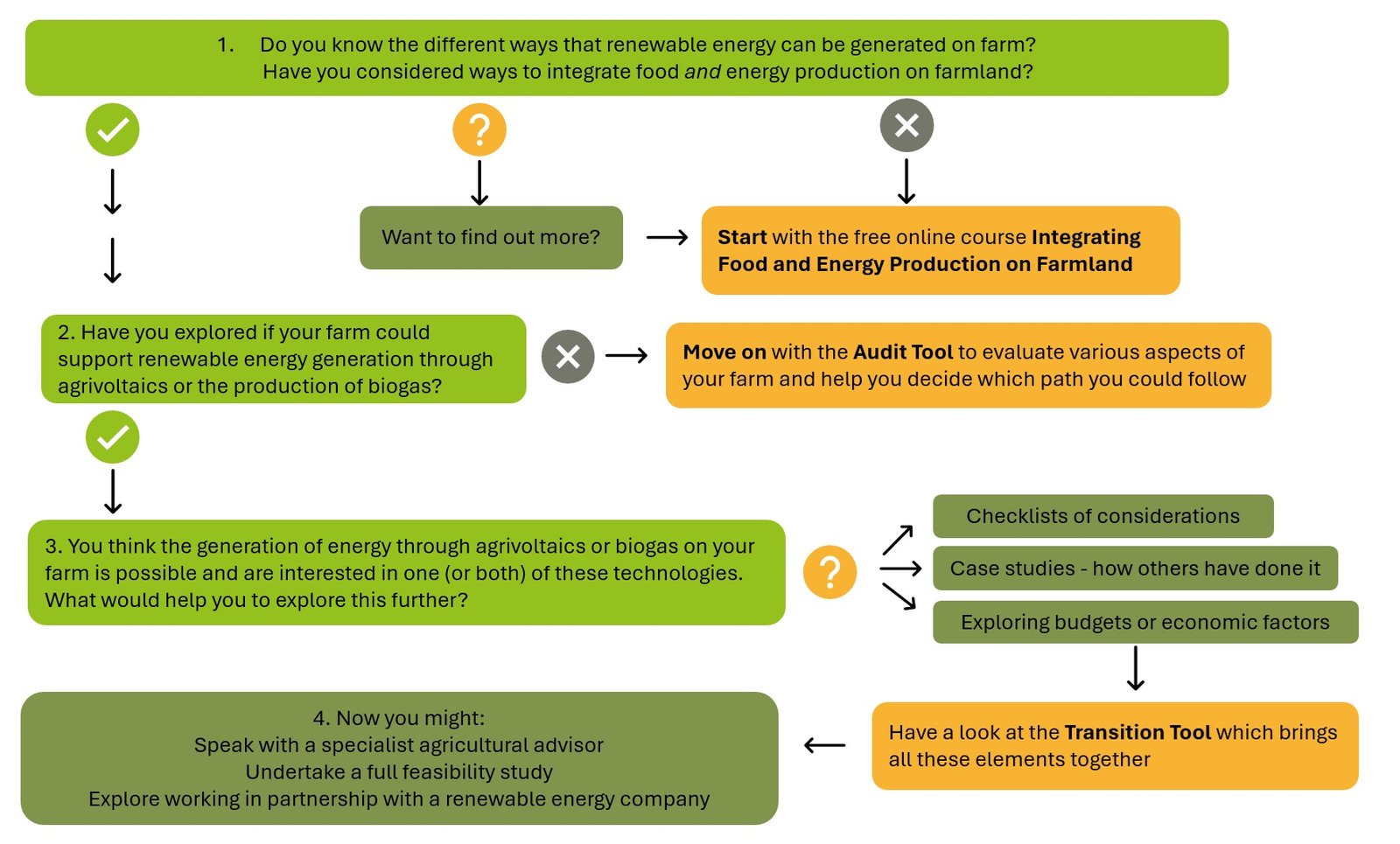
Have a look at the flowchart below to get started and then follow the links below the flowchart to the different parts of the DST.
📊 DST Flowchart
Integrating Food and Energy production on farmland available through FutureLearn
By answering a series of questions, this tool audits the potential to implement solar eneryg and/or biogas at your farm, considering the legal, economic, agronomic, social, and environmental aspects and impacts.:
Guidance on using the audit tool
Audit tool
Additional materials:
Crops and Agrivoltaics; Photovoltaic systems and configurations; Costs and Incomes; Action Plan Polish
  English
  French
  German
  Dutch
Dutch  Croatian
  Danish
  Italian
  Icelandic